
Education marketing / Guide 15
ASQA marketing and advertising rules: what an RTO can and cannot say.
The short answer
Your RTO's advertising should help a learner understand the course, the cost, and who will deliver it. Check the course details and funding claims before launch, and keep a record of who approved them. Your RTO remains responsible for marketing published on its behalf.
ASQA marketing requirements affect the ads a learner sees and the information they receive before enrolment. An attractive offer needs to match what your admissions team and trainers can deliver.
I recommend reviewing the ad and course page together, with your compliance lead involved before publication. This guide helps you prepare that review; it does not approve individual claims or replace legal advice.
Use the current rules in your approval checklist
The 2025 Standards took effect on 1 July 2025. Marketing and guarantees sit in Compliance Requirements 7 and 8. If your checklist still cites the marketing clause in the 2015 Standards, update its references. ASQA explains the current framework.
Keep the detailed legal references in the approval checklist. Your writers need a brief that tells them which course facts to use, which claims need evidence, and who can approve a change.
Your RTO needs oversight of partner marketing
The rules cover marketing published by the RTO and people engaged on its behalf. Outsourcing a campaign leaves the RTO responsible for it. Compliance Requirement 7.
Make each provider's role clear
Identify services delivered by an engaged expert or third party, including recruitment and training. Give your agency approved wording that explains who takes the enquiry and who delivers the course.
Keep permission beside the material it covers
ASQA's guidance calls for evidence of consent for people featured in marketing. Store approvals with graduate quotes, photographs, and partner material so the next campaign has a usable record.
Check the provider and course details first
Include your registration code or a link to its location on the National Register. For a training product, include its published code and title. Compliance Requirement 7.
Give writers one approved course record
Use training.gov.au as the reference for the code and title. Add the approved delivery details to your campaign brief. Ask your compliance lead to resolve space constraints in an ad before it goes live.
Confirm you can offer the advertised course
Check the course against your scope of registration, the list of training products your RTO is registered to deliver.
Review ads when a qualification changes
A superseded product can be advertised only while it remains on scope and new enrolments are allowed. Set a reminder for the transition deadline and include older brochures and partner pages in the review.
Distinguish nationally recognised training
Keep it clearly separate from other training. Review the use of the Nationally Recognised Training logo when both appear on the same page.
Explain who can receive funding
ASQA's guidance asks providers to make funding arrangements clear, including who provides support and any additional costs or effect on other entitlements. Funding contracts can add requirements. ASQA's information and transparency guide.
Before approving a funding headline, have the person responsible for your funding contract check it. The course page should explain eligibility, the fee payable, and how the learner can confirm their circumstances.
Keep career claims within what you can support
A licensed or regulated outcome needs confirmation from the relevant industry regulator. Retain that confirmation with the approved claim. Compliance Requirement 7.
Check promises made in calls as well as ads
ASQA warns against guarantees of successful completion, shortcuts that conflict with course requirements, and employment outcomes outside the RTO's control. Its guidance also addresses verbal promises. Review the admissions script alongside the campaign, especially where it discusses completion time or placement. ASQA's guarantees guidance.
Give learners enough information to decide
Outcome Standard 2.1 covers clear, current information before enrolment, including course delivery, support, fees, and student obligations. Put the details a learner needs on the course page and make the full terms easy to find. Outcome Standard 2.1.
Explain the suitability review
Standard 2.2 requires a pre-enrolment review of skills and competencies, including language, literacy, numeracy, and digital literacy. Tell prospective students what the review involves and how your team will help them understand their options.
The course page guide explains how to present these details without making the page difficult to read.
How Multiply Labs keeps RTO content compliant
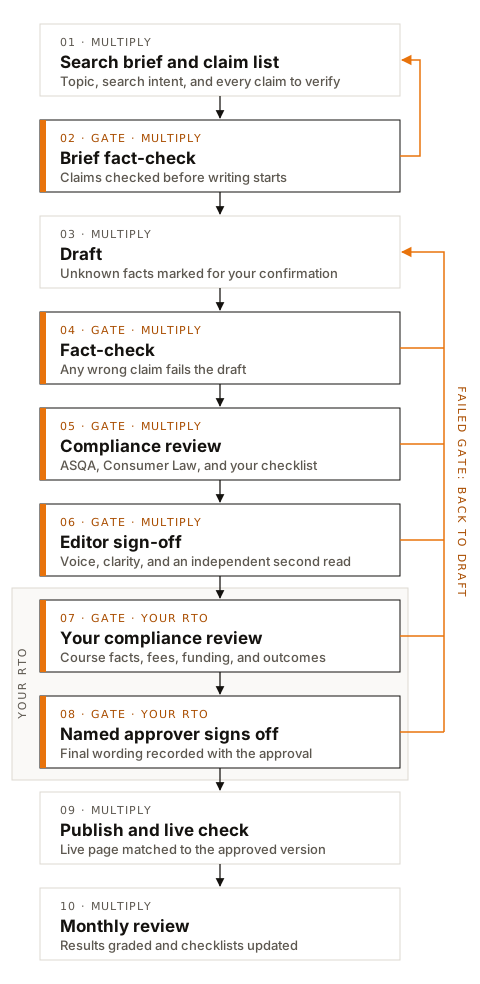
We write course pages, articles, and ads for RTOs. Four gates sit with us and two sit with your RTO. A failed brief check sends the work back to the brief; any later failed gate sends it back to the draft.
Your gates come last. Your reviewers see a version that has already passed ours, so their time goes on the facts only they can confirm.
We fact-check the brief before anyone writes
The brief lists every claim the piece will make: codes, prices, durations, placement, accreditation, funding, and outcomes. We check each one before drafting, so an error in the brief cannot travel into the copy. One recent brief carried 69 claims; 16 were wrong in the first round, and it passed on the third.
A typical article carries between 28 and 71 checkable claims. Where your records do not settle a fact, the draft marks it as a question for your team and leaves the number out.
Each claim needs a primary source we can link
Each type of claim has one authority, and we check it there:
- Course, fee, and policy facts: your catalogue, fee schedule, course guides, and policies.
- Codes, titles, currency, and scope: training.gov.au, even when your catalogue lists them.
- Regulatory claims: the 2025 Standards, ASQA's practice guides, and the Australian Consumer Law.
- Enrolment, labour market, and pay figures: NCVER, Jobs and Skills Australia, and the Fair Work Ombudsman.
Each claim ends verified, wrong, or unverified, and a partly right claim counts as wrong. The link goes to the exact page or PDF page, and a dated source gets a second search for anything that changed after its date. If we cannot link a claim, it comes out.
The checks catch errors in briefs, drafts, and course guides
These came from work with one RTO client:
- A brief recommended a qualification code that training.gov.au listed as non-current.
- A draft overstated a professional accreditation. The copy now states it exactly as granted.
- Two course guides gave a short-course price and a work placement that no longer applied. The client settled the facts, and those guides stopped being a source for those courses.
- One weekly price passed our fact-check and our compliance review because our course record was out of date. The client's reviewer caught it. Every price now gets an arithmetic check: the weekly figure doubled must equal the fortnightly figure.
That last error is why your reviewers keep the final two gates: our checks rely on the records you give us.
Your team makes the final call
Your compliance team, with the person responsible for course delivery, reviews each piece against your policies and records. A named approver then signs off the final wording.
After publication we check the live page against the approved version and ask Google to index it. The monthly report grades what went live and feeds any new rule back into the checklists below.
One batch of course articles took about six weeks from draft to live, most of it spent waiting on the client's answers to our questions.
We check every piece against three sets of rules
ASQA and the Australian Consumer Law
Every rule in the sections above, plus:
- Entry requirements, duration, delivery mode, fees, and placement stated before enrolment.
- A total price, including all unavoidable fees, at least as prominent as any weekly or upfront figure, under the ACCC's price display rules.
Our own standards
- A source and a date for every statistic; salary figures matched to the industry and less than 12 months old.
- Code and title strings matched to training.gov.au character for character.
- Articles that answer research questions and link to the course page, without competing for enrolment searches.
- No competitor names, and no “best”, “only”, or “number one” claims.
- A fresh editor sign-off after any change to approved copy.
Your marketing policies, added to every brief
- No employment guarantees, and an external source for every salary figure.
- Work placement described as guaranteed only where the placement is confirmed for that course.
- “Nationally recognised” kept off courses outside the national training system.
- Professional accreditations stated exactly as granted.
- Your own marketing compliance checklist, applied before a piece reaches your reviewers.
Keep a record of the version you approved
Give one person responsibility for collecting the final ad, destination page, and supporting evidence. Before publication, ask them to confirm:
- The course details match the approved brief.
- The funding and outcome claims have the required review.
- Partner responsibilities and permissions are documented.
- The admissions team has the same information as the learner.
- Someone owns the next review date and the removal of old material.
Read the whole offer as a learner would
ASQA also flags misleading advertising under Australian Consumer Law. Check the impression created by the headline, image, and conditions together. A claim needs support beyond a footnote. ASQA's advertising risks.
Keep specialist questions with the right reviewer
Funding, licensing, and individual ad formats can need specific advice. Record the question and the decision in the approval file so it is available when the campaign is revised.
For campaign planning, see the education marketing guide, Google Ads for RTOs, and Facebook ads for training organisations.
Sources and review date
Frequently asked questions
Is ASQA clause 4.1 still current?
The marketing clause in the 2015 Standards has been replaced. Use Compliance Requirements 7 and 8 in the 2025 Standards when reviewing marketing and guarantees. Read Compliance Requirements 7 and 8 (PDF, pages 5–6).
Does my RTO code have to appear in every ad?
The requirement allows the registration code or a link to its location on the National Register. Ask your compliance lead to confirm how the proposed ad format meets the rule before publication.
Can we advertise a superseded qualification?
Only while it remains on your scope and new enrolments are permitted. Check the applicable transition deadline before renewing a campaign.
Who checks an agency's advertising?
Multiply fact-checks marketing material before sending it to you. Client approval is mandatory in Multiply’s process, including for AI-assisted content. A named person at your RTO must check the course details, fees, funding eligibility, and outcome claims against your current records and approve the final version before publication. ASQA’s AI principles explain how human oversight and accountability support providers’ existing obligations. Read ASQA’s principles for responsible AI use.